A chatbot answers questions. An agent gets a job done.
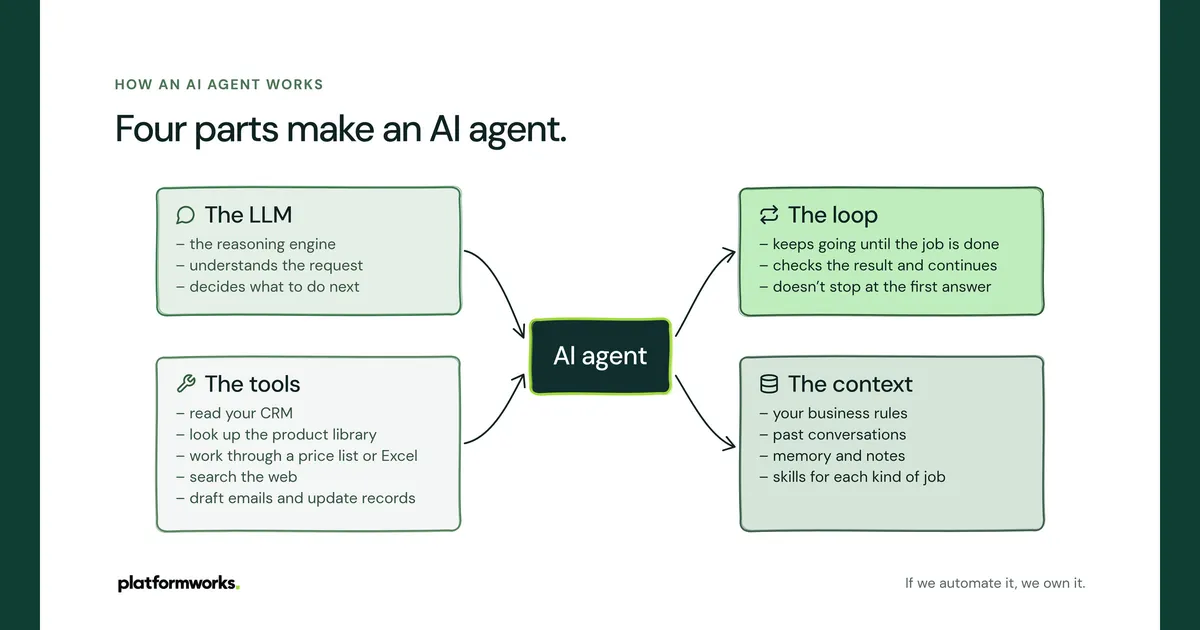
The difference is not a cleverer chat window. It is how the agent is put together. Four parts do the work: the model (the LLM, or large language model), the tools, the loop and the context. Take one away and you are back to a chatbot that stops after the first reply.
Here is what each part does, and how they come together in Bob, a presales agent we have built to work alongside a salesperson on technical deals.
The four parts
The LLM (the reasoning engine)
The large language model is the part that understands language and decides what to do next. That model might be Claude Opus, GPT-6 Astra, or another large language model. It does not hold your prices or your customer records on its own. It reads what it is given, plans the steps and writes the drafts. Think of it as the reasoning engine, not the filing cabinet.
The tools
Tools are how the agent uses your systems the way a person would: read the CRM, look up a product library, work through a price list or an Excel workbook, search the web, draft an email or update a record. Without tools, the model can only talk. With them, it can do the job.
The loop
The loop is what stops the agent at a finished job, not at the first answer. It plans, uses a tool, checks the result, and keeps going until the work is done or a person needs to approve something. That is why an agent can scope, design and price a deal in one run, rather than handing you a single reply and waiting to be asked again.
An agent can start when someone asks, on a schedule, or on a trigger, such as a new CRM record or an inbound email.
The context
Context is the business knowledge the agent works from: your rules, past conversations, memory and notes, and the skills (the instructions for each kind of job). Bob needs your product library, pricing rules, proposal templates and the questions a presales engineer would ask. Without that, even a strong model is guessing.
How Bob uses those four parts
Bob is a presales agent. He is built for technical businesses that already have a design team or a technical presales team, and he works alongside the salesperson rather than instead of them.
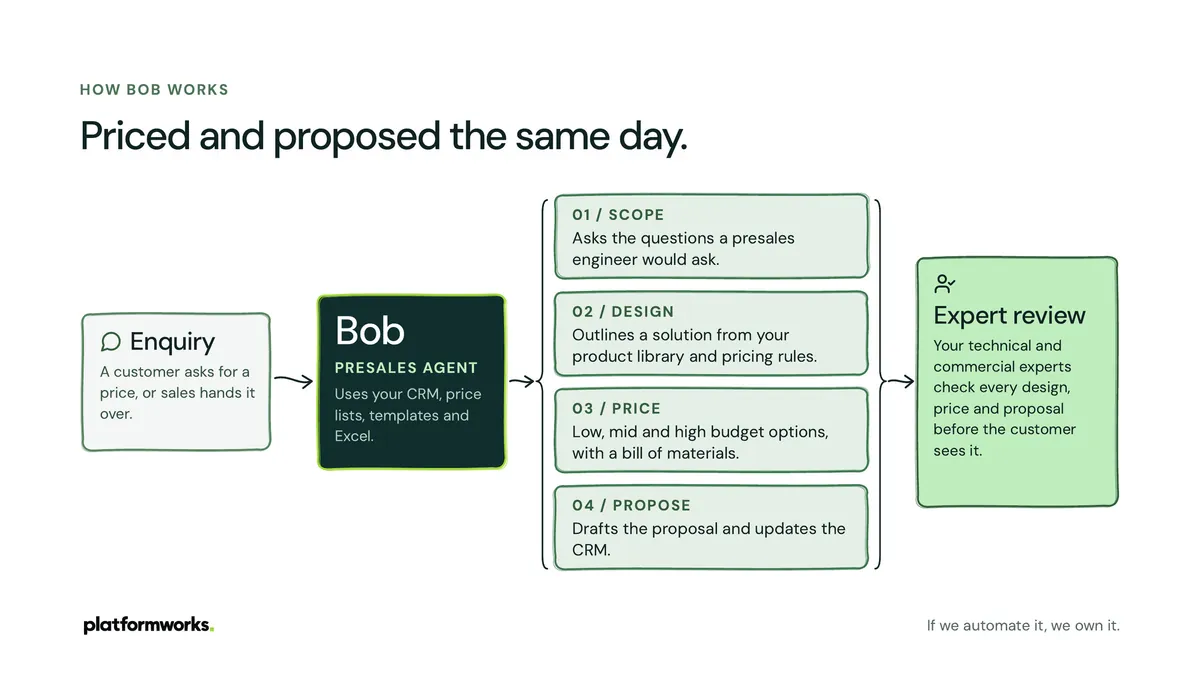
It starts with an enquiry: a customer asks what a solution will cost, or a salesperson hands it over. Bob then works through four steps, using your CRM, price lists, templates and Excel:
- Scope. He asks the questions a presales engineer would ask.
- Design. He outlines a solution from your product library and pricing rules.
- Price. He produces low, mid and high budget options, with a bill of materials.
- Propose. He drafts the proposal and updates the CRM.
Your technical and commercial experts then check every design, price and proposal before the customer sees it.
That same-day turnaround is possible because the loop does not stop after the first question, the tools already have the product and pricing data, and the context holds the way your team designs and writes. The model is doing the reasoning. The experts still make the call.
What your team gets
Four things, ready for review:
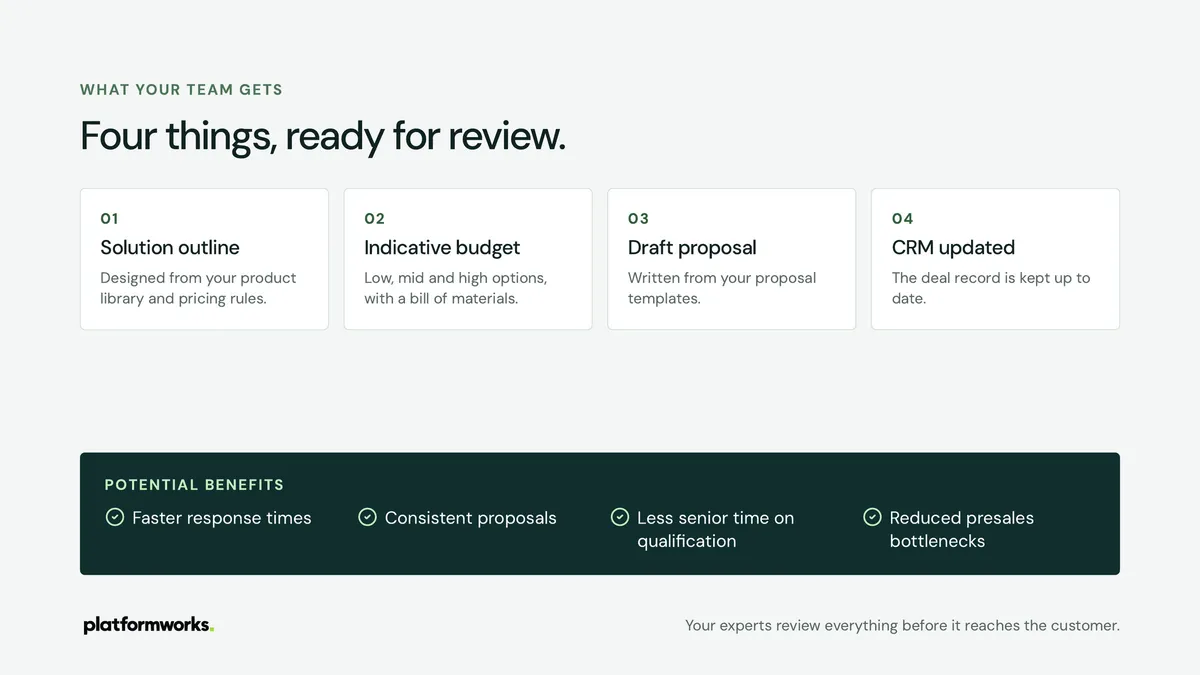
- A solution outline, drawn from your product library and pricing rules
- An indicative budget, with low, mid and high options and a bill of materials
- A draft proposal, written from your templates
- The CRM updated, so the next person to pick up the deal can see what has been done
The potential benefits are straightforward: faster response times, more consistent proposals, less senior time spent on qualification, and fewer presales bottlenecks. None of that replaces the expert review. It just means the experts start from a complete draft, not a blank page.
What Bob will not do
- Send a design, price or proposal to the customer before your experts have reviewed it.
- Invent products or prices that are not in your library and rules.
- Replace your technical or commercial team. He takes the first pass off them so they can spend their time on the judgement that matters.
If you want a closer look at what an agent should be allowed to change in your business, we have a separate guide on approvals and guardrails.
And if you are comparing this with a sales prospecting agent, Outbound agents: how they work is the companion piece.
Want to see Bob working?
Ask for a demo and we will show you, live on a call, how a presales agent would handle a job like yours: what starts it, what it does, which systems it uses and what your team approves.